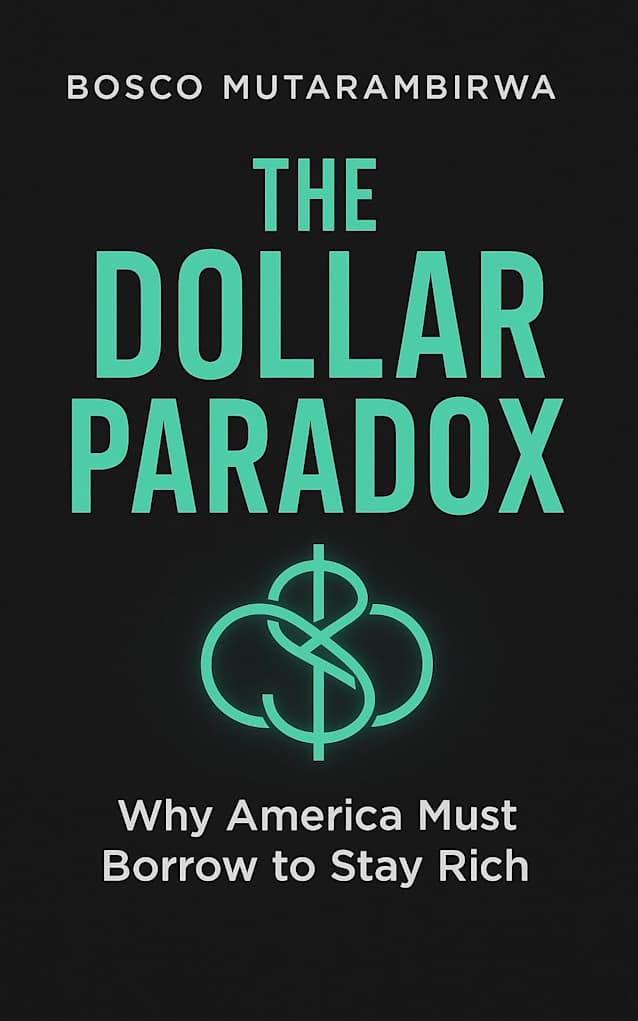
The Dollar Paradox
About
The belief that U.S. debt signals economic failure is wrong.
Persistent borrowing is a structural requirement of the global dollar system.
The United States issues the world’s reserve currency. That role obliges it to supply dollar liquidity to the global economy—an obligation that can only be met through persistent deficits and rising public debt. What is commonly described as fiscal irresponsibility is, at the system level, a functional necessity.
The Dollar Paradox: Why America Must Borrow to Stay Rich explains why U.S. debt is neither a temporary policy error nor a countdown to collapse, but the predictable outcome of how modern money, trade, and financial stability are organized. The paradox is not that the United States borrows so much, but that the global system depends on it doing so.
In clear, non-technical language, Bosco Mutarambirwa explains:
Why global demand for dollars forces persistent U.S. deficits, regardless of political leadership or stated fiscal intentions.
How U.S. Treasuries became the foundation of global finance, serving as the world’s primary reserve asset and collateral base.
Why inflation control, liquidity injections, and financial backstops are systemic mechanisms rather than evidence of breakdown.
What an actual dollar crisis would involve, and why most popular collapse narratives misunderstand the mechanics.
Why household-budget analogies consistently mislead debates about national debt and sustainability.
This is not a book about American decline, nor a defense of reckless policy. It is a structural analysis of monetary power—and why the issuer of the world’s reserve currency cannot behave like a conventional debtor without destabilizing the system it anchors.
Who this book is for:
Readers interested in global finance, monetary policy, geopolitics, or long-term economic stability who want an explanation grounded in structure rather than rhetoric.
If you want to understand how the dollar system actually works—rather than how it is commonly portrayed—read this book.