A funding agreement can keep services running. A durable partnership also needs local authority, public accountability and a transition patients can survive.
A health partnership should be judged at the clinic, not only at the signing table. Medicines must arrive, staff must be paid, and patients must be able to return for care. Beside those practical measures belongs another test: who has the authority to decide how the system develops?
Zambia's agreement with the United States, signed on October 8, makes that question concrete. Zambia's foreign ministry https://www.mofaic.gov.zm/?p=4503 says Washington will provide more than $1.5 billion over five years and Zambia will add $975 million in domestic health expenditure. Lusaka Times https://www.lusakatimes.com/2026/10/08/zambia-usa-seal-health-deal/ reports the same commitments. Financing creates an opportunity. Implementation determines what it becomes.
Read the conditions, not just the headline
The public descriptions of health-data provisions need careful reading. Associated Press reports https://apnews.com/article/926edb9ab38b144bb1b83f73e5645f1b that contentious patient-data and specimen-sharing clauses were removed. Zambia's official announcement nevertheless says a separate Data Sharing Agreement was signed. Those statements need not describe identical obligations. They do not justify concluding that all information exchange has ended.
Publishing the final instruments and explaining what information moves, for which purposes and under whose oversight would make the partnership easier to assess. Health GAP's analysis https://healthgap.org/activists-challenge-coercive-us-zambia-health-deal-terms-and-win/ argues that civil-society pressure improved the terms. That is an advocacy assessment, which should be distinguished from the governments' account.
There is a similar need for precision about minerals. Reuters, carried by Mining Weekly, reports https://www.miningweekly.com/article/zambia-says-it-is-negotiating-us-minerals-deal-after-decoupling-from-health-pact-2026-10-08-1 that Zambia's foreign minister says minerals negotiations have been separated from the health pact. A health agreement and a commercial negotiation deserve scrutiny on their own terms.
Three tests for a durable partnership
Authority. Can national institutions set priorities and scrutinize the conditions attached to support? Local ownership needs decision-making power as well as a local signature.
Continuity. Does the financing transition have a credible fallback if revenue, staffing or procurement falls short? Assuming responsibility faster than resources arrive can leave a clinic with an obligation it cannot meet.
Accountability. Can patients and local organizations see what was promised and challenge failures? A timetable is useful only when people can check whether it protects services.
These are implementation questions, not claims that the new agreement has already failed. Neither accepting assistance nor reducing reliance on it automatically proves success.
The deeper argument
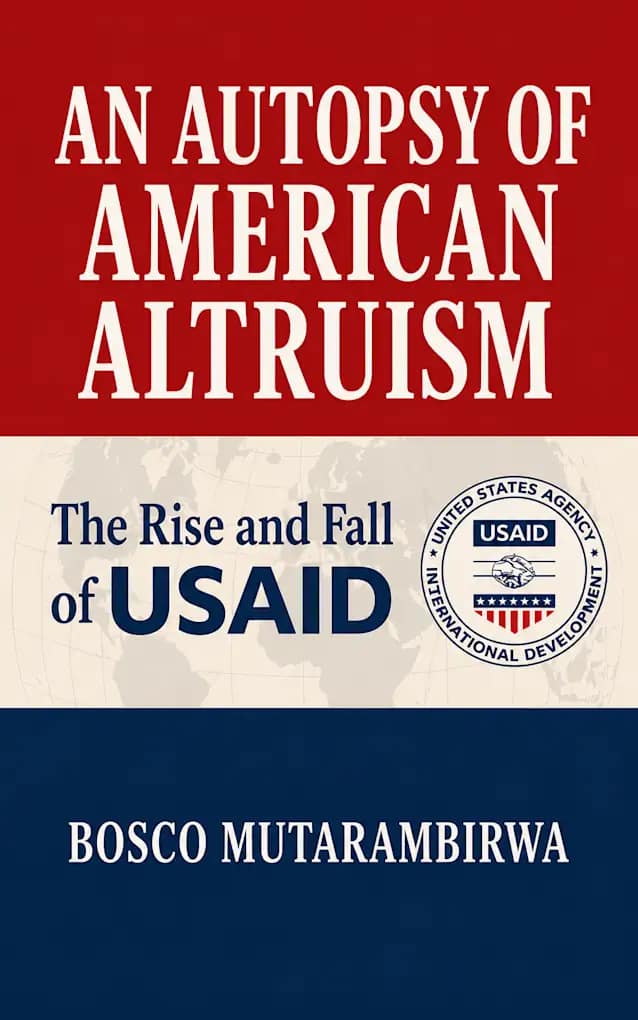
In An Autopsy of American Altruism: The Rise and Fall of USAID, Bosco Mutarambirwa examines the tension between promising self-reliance and retaining control over its terms. Chapter 4 traces USAID's founding commitment to institution building alongside contractor-led delivery and unequal influence over planning. Chapter 17, Dignity Beyond Dependency, connects autonomy to local voice and accountability to domestic constituencies.
The distinction matters: transferring costs is not the same as transferring authority. The manuscript also distinguishes ownership from guaranteed better outcomes. Its argument offers a lens for the agreement, not proof that withdrawal of aid improves care.
A strong partnership should enlarge the capacity to govern while protecting the people who depend on delivery. The most useful verdict will come from what national institutions can decide, what clinics can provide and what citizens can hold both governments to.
For the deeper institutional history behind that question, read An Autopsy of American Altruism: The Rise and Fall of USAID by Bosco Mutarambirwa on Amazon https://www.amazon.com/dp/B0G443DM1Y