Wall Street is having an extraordinary year. The question for New York is what that success changes beyond the trading floor.
An October 6 report from New York State Comptroller Thomas P. DiNapoli puts securities firms’ first-half pretax profits at $45.9 billion, up 51.3% from a year earlier. This measures broker-dealer profits—not money deposited into the city’s budget. The distinction matters before anyone starts spending the headline.
Source: https://www.osc.ny.gov/press/releases/2026/10/wall-street-first-half-profits-soar-nearly-46-billion
A city can prosper unevenly
A separate October 1 comptroller report finds New York City’s retail employment still 14.4% below its 2019 level. Those reports describe different sectors, not proof that one caused the other’s difficulties. Together, however, they challenge the idea that a strong financial district automatically means an easy year for a neighborhood shop.
Source: https://www.osc.ny.gov/press/releases/2026/10/dinapoli-recovery-nyc-retail-remains-uneven-sales-increase-job-growth-stalls
For a store owner, recovery is experienced through customers, staffing costs and a lease. For a commuter, it is experienced through time, reliability and the cost of getting to work. For a city government, it arrives through revenue collections, service demands and obligations that continue after a good market year ends. These are connected economies, but they are not interchangeable balance sheets.
The useful argument is about the transmission mechanism. Which gains become dependable public revenue? Which investments make daily life less costly? Which spending promises remain affordable if the next market cycle reverses? A profitable industry can help support the city while leaving those questions unresolved.
What Red Mayor, Green Money brings to this debate
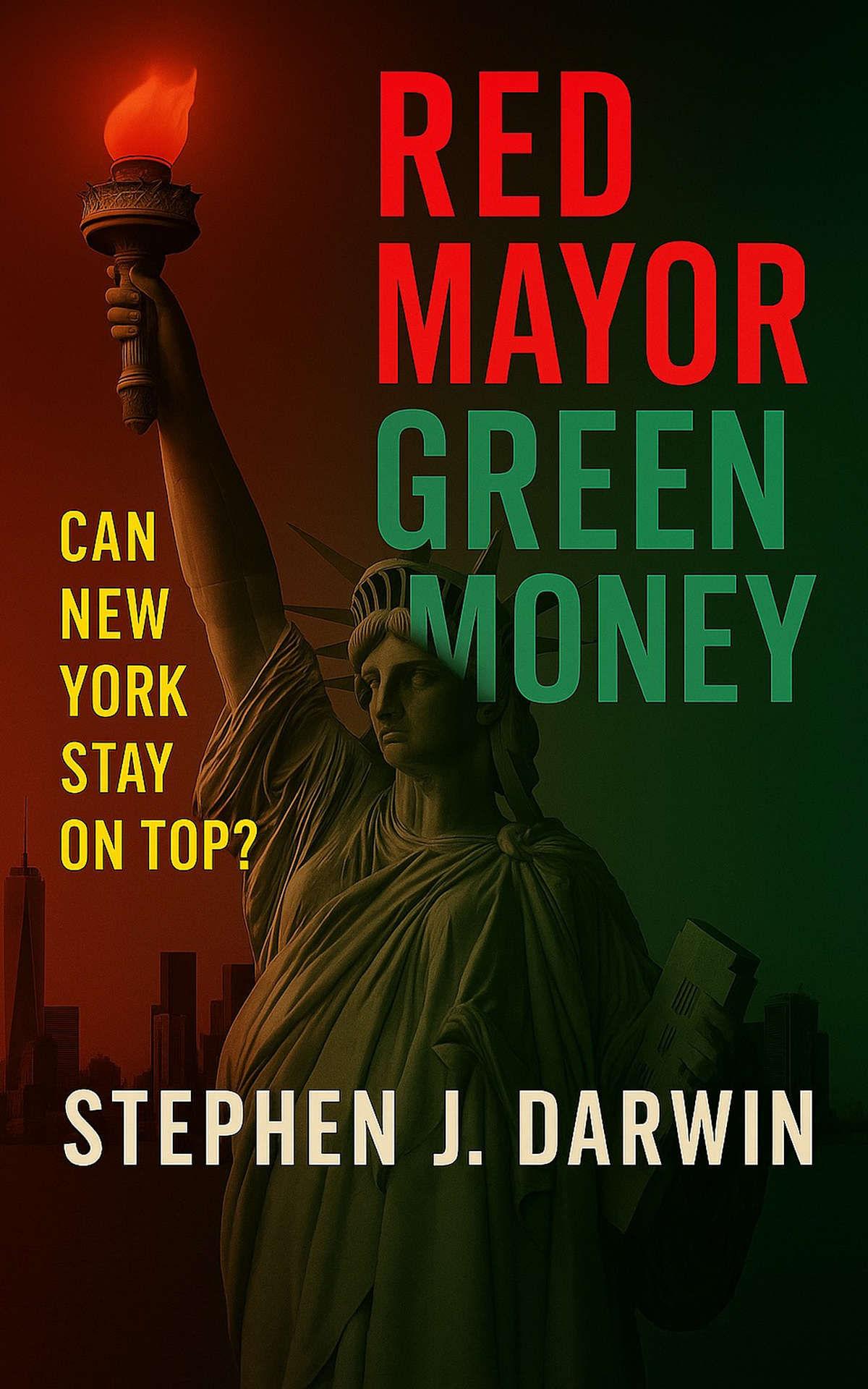
Stephen J. Darwin’s Red Mayor, Green Money: Can New York Stay On Top? examines that tension through a political and economic scenario. Its published manuscript uses fictionalized names and imagined situations; it should be read as a stress test of choices, not a factual account of the current administration or a prediction that events must unfold a particular way.
In the opening chapter, the book moves between the perspective of financial decision-makers and the pressure facing workers and neighborhood businesses. Its discussion of Main Street emphasizes predictable rules, reliable transit and affordable essentials. Its discussion of Wall Street emphasizes confidence and the cost of uncertainty. Neither perspective removes the need to account for the other.
One especially useful idea is that New York’s appeal rests on a cluster of advantages: talent, proximity, expertise and the city’s wider cultural pull. Those advantages help explain why capital stays. They also create a practical test for policy: does a proposed change strengthen the conditions that make the city productive, and can residents share in the result?
Three questions worth asking now
First, distinguish recurring revenue from a market windfall. A permanent service commitment should have a funding explanation that survives a weaker year.
Second, connect economic policy to the ordinary cost of participating in the city. A faster commute, a workable permit process or a more affordable home may matter more to a household than another record in a financial headline.
Third, demand a clear account of trade-offs. Keeping investment attractive and improving affordability both require implementation, not just declarations of intent. The strongest proposals should show how the two objectives interact.
Wall Street’s good news is real. So is the need to ask what it means for the rest of New York. Red Mayor, Green Money offers a longer lens for readers who want to examine that governing problem beyond the next headline.
Explore Red Mayor, Green Money by Stephen J. Darwin: https://www.amazon.com/dp/B0FXH4ZNLJ
Darwin Publications publishes the featured book. This article is editorial commentary, not investment advice.
October 9, 2026
Wall Street’s $45.9 Billion Boom Meets New York’s Everyday Economy