AI can help a young person make a name, image, or website in minutes. It cannot prove that anyone needs the business. The stronger starting point is a customer problem, a bounded promise, and a test that produces evidence.
The tools for starting a business have never looked more accessible. A young person can ask an AI system for a company name, generate a logo, draft a flyer, and assemble a simple website before lunch.
That speed is exciting. It also creates a new way to get the order wrong.
A polished identity can appear before there is a customer, a useful offer, adult permission, a workable delivery process, or any evidence that the idea solves a real problem. The result may look like a business while remaining only a collection of assets.
This distinction matters in a world preparing for a severe youth opportunity gap. The World Bank says 1.2 billion young people in developing economies will reach working age over the next 10 to 15 years, while those economies are projected to create only about 420 million jobs. Current reporting from the World Bank and IMF meetings also points to AI as both a productivity opportunity and a source of disruption, especially for entry-level work.
Entrepreneurship education belongs in that conversation. But it should teach judgment, not just launch speed.
Start with the trouble, not the product
The first useful question is not, "What can I sell?" It is, "Who is having trouble, what gets in the way, and what better result would help?"
That three-part problem statement comes before product design. A vague idea such as "people need cool things" offers nothing to investigate. A specific observation, such as students losing time because small supplies disappear inside crowded backpacks, creates a testable lead.
The next step is to notice the workaround. People often reveal the importance of a problem through what they already do: repeat a reminder, rewrite an unreadable sign, ask a relative for help, or improvise a temporary fix. A workaround does not prove that someone will pay. It proves that the problem exists outside the builder's imagination.
This is a crucial discipline in an AI-rich environment. A tool can generate ten product concepts quickly. It cannot substitute for observing the real "stuck moment" that gives one concept a reason to exist.
Name one customer, not everybody
Young builders often describe their market as "everyone." That is not a customer group. A useful customer description begins with a role and a job to be done.
An event guest may use a place card, while the event organizer decides whether to obtain it. A club member may read a poster, while the club leader decides what information belongs on it and a school may need to approve it. The user, decision-maker, and approver can be different people.
Evidence should come from the person who experiences the need or makes the decision. Instead of asking, "Wouldn't you buy this?" a young builder can ask what happened the last time the person faced the problem, what they did, how often it occurs, and what effort or money it already costs.
Compliments are pleasant. Past behavior and specific workarounds are more informative. Neither is permission to sell.
Turn the idea into a bounded promise
An idea is a possibility. An offer is a specific promise about what someone receives and what is expected in return.
"I make custom stationery" leaves both sides guessing. A bounded offer identifies the intended customer, the exact unit, what is included, and the limits or conditions. One matched set of ten readable place cards with a choice of two borders is something a buyer can picture and a builder can evaluate.
Narrowing the offer is not thinking small. It creates a promise that can be understood, tested, priced, and kept.
The same principle applies to an AI-generated service. "I make anything digital" is not credible. One clearly defined deliverable, one permitted tool, one revision limit, and one quality check form a much stronger beginning.
Test before spending
Before buying inventory or announcing a launch, build the smallest version that can answer one important question.
A physical product may need one sample. A service may need a safe rehearsal. A digital offer may need one original practice file created with an approved tool. The goal is not applause. It is to discover a weakness while it is cheap and easy to change.
One sample is not inventory. A prototype answers a question; inventory consists of finished items held for possible orders. Producing a pile too early can lock money and effort into something nobody needs or something that must be remade.
The test should separate observation from hope. "The participant liked the blue border" is preference feedback. "The participant could not read a long name" is a direct usability observation. Neither is a sale.
Put the brand after the evidence
A name and visual identity can help customers recognize a useful offer. They cannot make an untested offer useful.
A good working name is understandable, truthful, distinct enough to investigate, and consistent with the actual scope. A tagline should describe the promise without claiming results that have not been demonstrated. A simple paper sketch can be enough at first. Readability matters more than decoration.
This is where AI tools can help, after the builder has earned clarity. They may speed up drafts, comparisons, and presentation. The customer problem, evidence, permissions, cost logic, and responsibility still require human judgment.
Teach the repeat button
A one-time paid task and a business are not the same. A business has a repeatable way for someone to understand the offer, request it, receive the promised result, and resolve a mistake.
That repeat button depends on connected pieces: customer, problem, offer, operating system, money plan, and responsibility. Missing one can leave an idea looking exciting but unready.
OECD guidance treats communication, planning, organization, problem-solving, and critical thinking as central entrepreneurship competencies. UNICEF and ILO programs likewise connect youth entrepreneurship with practical skills for changing labor markets. The lesson is bigger than telling every child to become a founder. It is teaching young people to observe, test, calculate, communicate, and make honest decisions from evidence.
That is the durable advantage. AI can make the first draft faster. It cannot decide whether the promise deserves to be made.
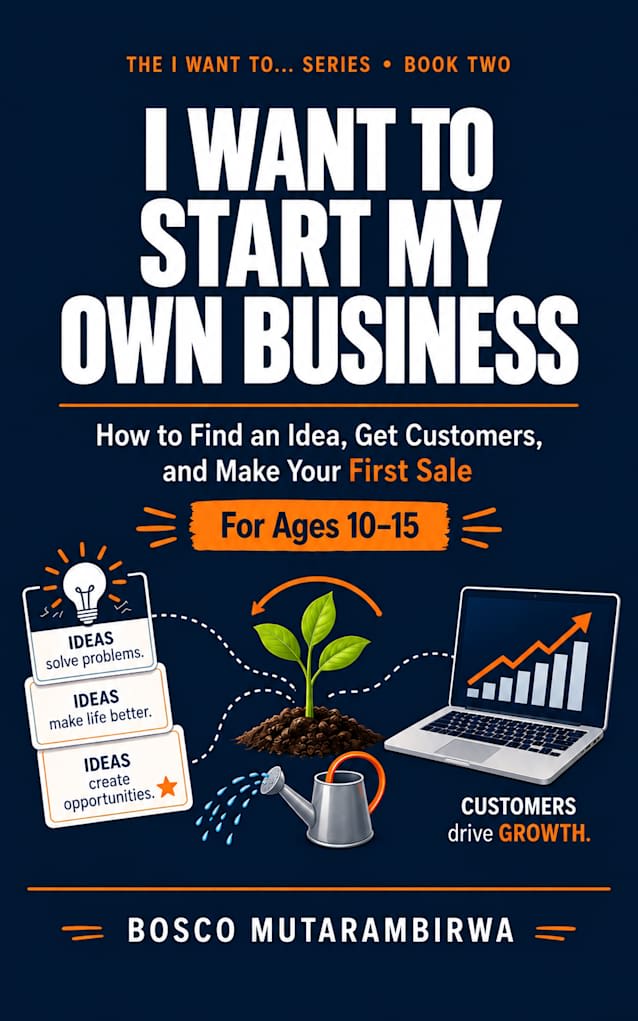
For families, homeschoolers, teachers, and youth programs that want a complete, supervised path from problem discovery to a Business Blueprint, read I WANT TO START MY OWN BUSINESS by Bosco Mutarambirwa: https://www.amazon.com/dp/B0HN6X1WHN
Sources: World Bank Youth Summit 2026; World Bank Jobs Strategy and Annual Report; Reuters, Oct. 17, 2026; Financial Times, Oct. 18, 2026; The Guardian, Oct. 18, 2026; Indian Express, Oct. 13, 2026; OECD entrepreneurship skills resources; UNICEF youth skills resources; ILO Ready for Business.
https://www.worldbank.org/en/events/2026/06/11/youth-summit-2026-future-works-designing-jobs-for-the-digital-age
https://www.worldbank.org/en/about/annual-report/leadership-perspectives
https://www.reuters.com/world/high-debt-growing-strains-put-focus-need-new-development-approaches-2026-10-17/
https://www.ft.com/content/c6aeb3a1-1874-4947-8ffc-4d993301244a
https://www.theguardian.com/technology/2026/oct/18/world-bank-artificial-intelligence-developing-economies
https://indianexpress.com/article/business/india-leader-ai-diffusion-scale-new-jobs-small-businesses-nandan-nilekani-10919469/
https://www.oecd.org/en/publications/incubation-in-entrepreneurial-ecosystems_21be9d03-en/full-report/entrepreneurship-skills-training_f77ad336.html
https://www.unicef.org/lac/en/developing-specific-skills-work-or-entrepreneurship
https://learninghub.ilo.org/program/Ready_for_Business_R4B